

Child Care & Early Education
A research-driven regional brief designed to turn child-care affordability, workforce, quality, and economic data into a clear policy conversation for families, employers, providers, and public leaders.
Translate a complex regional issue into a clear conversation.
The six-page brief was built to make the child-care conversation easier to understand without oversimplifying it. It connects the needs of children and families with the realities facing employers, early childhood educators, providers, and the regional workforce.
Affordability + Quality
Frame the tension between what working families can reasonably afford and what it costs to provide high-quality care.
Workforce Infrastructure
Show child care as economic infrastructure—supporting parents' ability to work while depending on a strong early childhood workforce itself.
Early Learning
Connect access to care with language, literacy, mathematics, social-emotional development, relationships, and school readiness.
The core question: How do we lower the burden on families without lowering the standard of care?
Use the numbers to clarify the stakes—not overwhelm the reader.
The report pulls together regional wage context, statewide child-care workforce data, economic-impact research, early-learning evidence, and employer policy information, then translates those sources into a visual narrative that can be scanned quickly in a meeting.
$6.65B
Estimated annual economic cost to Pennsylvania from inadequate child care.
2,600+
Reported unfilled child-care jobs in Pennsylvania.
22,000
Additional children who could potentially be served if those positions were filled.
$27.31/hr
Average wage across all occupations in the Scranton–Wilkes-Barre metro area cited in the brief.
$4–$11
Estimated lifetime benefits for every $1 invested in one intensive early-education program studied.
40% / 50%
Expanded 2026 federal Employer-Provided Child Care Credit rates highlighted for qualified employers and eligible small businesses.
Make each page answer one question.
Rather than treating the document like a research paper, the content was structured as a sequence of visual arguments. Each section moves the conversation forward while keeping the regional context visible.
01 — Why It Matters
Establish children, families, and employers as three interconnected audiences affected by the strength of the child-care system.
02 — The Funding Gap
Use a visual balance between family affordability and the true cost of quality to define the central challenge.
03 — Child Care Powers the Economy
Connect workforce participation, employer productivity, open classrooms, educator shortages, and regional wages.
04 — More Than Child Care
Shift from economic infrastructure to child development, early learning, and long-term outcomes.
05 — Supporting Opportunity
Address family choice and identify practical areas for collaboration across providers, employers, educators, community organizations, and government.
06 — The Opportunity for NEPA
Close with a systems-level view: quality early education, affordable reliable care, strong providers, and workforce participation reinforce one another.
A policy document that could still be read in the room.
The visual system was built around strong hierarchy, short reading paths, regional data callouts, diagrams, and repeated color cues. Dense research was broken into sections that could work both as a complete six-page brief and as individual talking points during a live conversation.
Hierarchy
Large section headlines and short framing statements establish the main idea before the supporting detail.
Visual Translation
Funding gaps, workforce cycles, family choices, and partnership opportunities are shown as systems rather than buried in paragraphs.
Executive Readability
Key numbers and conclusions are intentionally separated from source detail so leadership can navigate the brief quickly during discussion.
Prepared for a policy conversation.
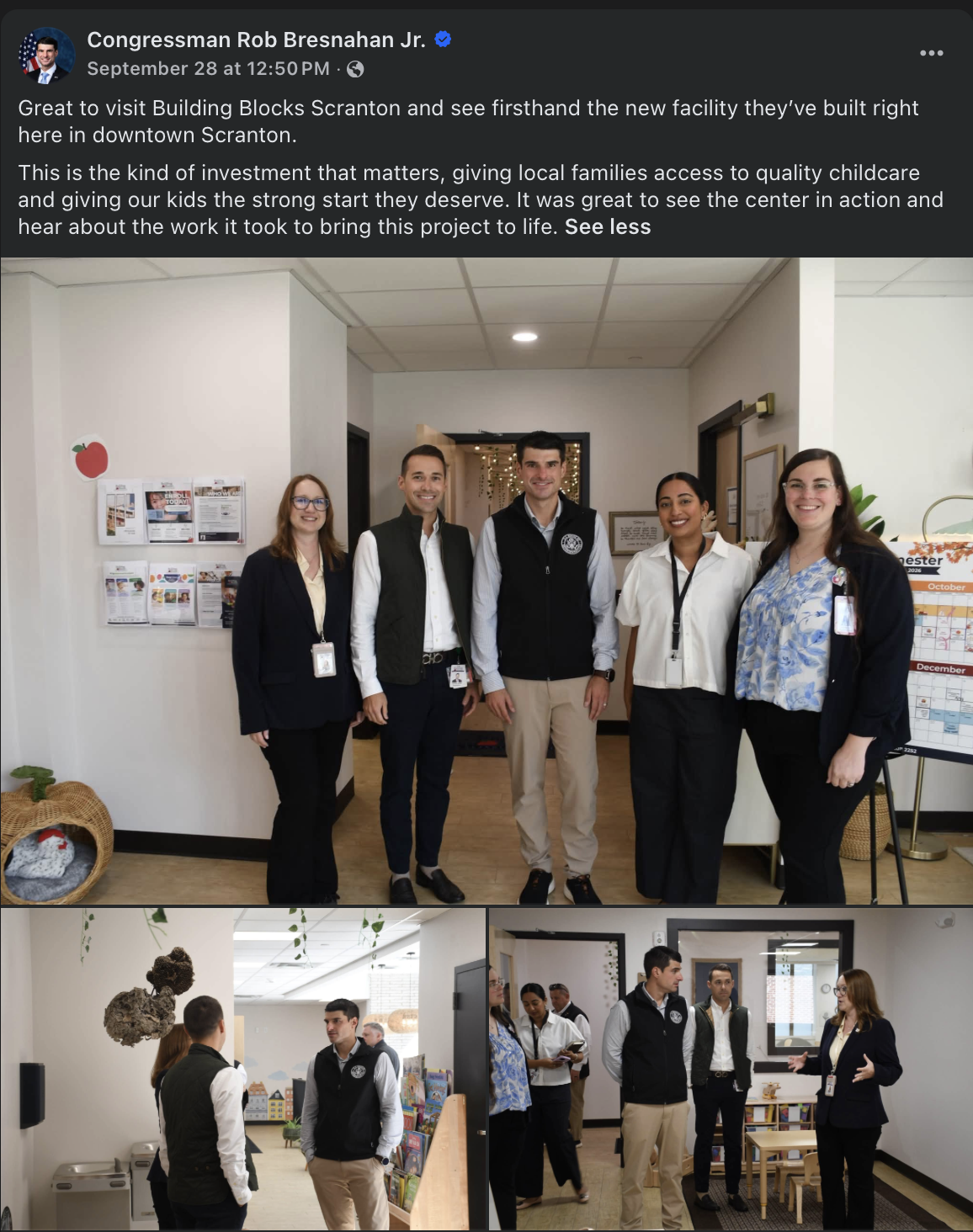
The brief was prepared for Building Blocks Learning Center leadership and presented by the President/CEO during Congressman Rob Bresnahan Jr.'s visit to the Scranton center. The visit included a tour of the new downtown facility and discussion around child-care access, workforce challenges, early education, and policy considerations affecting families and providers.
From research to the room.
The final deliverable was not created as a passive report. It was designed to support leadership in a live, high-level conversation—giving the organization a concise way to connect regional operating realities with broader policy questions.
Public context
Following the visit, Congressman Bresnahan publicly highlighted the Scranton facility and described local access to quality child care as an important investment for families and children.
Research, structure, design, and executive communication.
Research + Synthesis
Compiled and organized economic, workforce, early-learning, regional wage, and policy information into a focused narrative.
Messaging + Structure
Shaped the document around a sequence of questions and arguments rather than a collection of disconnected statistics.
Information Design
Designed the six-page brief, including data callouts, diagrams, visual hierarchy, and the overall editorial system.
Regional Framing
Connected statewide and national research to the specific affordability and workforce context of Northeastern Pennsylvania.
Executive Communications
Created a document leadership could use as a concise briefing tool during an in-person policy discussion.
Policy Storytelling
Balanced family affordability, provider quality, workforce needs, early learning, and employer participation without reducing the issue to a single perspective.